
 Baku 24° C
Hikmat Hajiyev: Azerbaijan ready to deepen energy co-op with EU
- 01 December, 2025
- 12:40
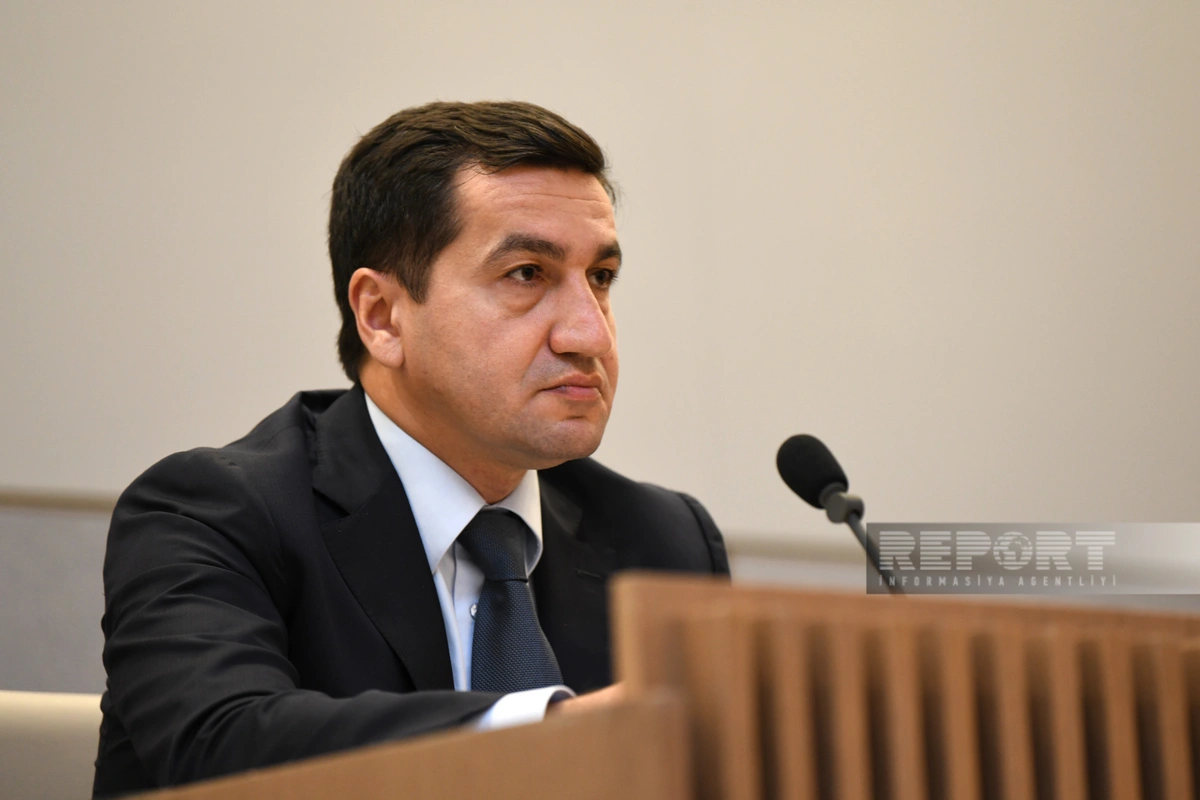
Azerbaijan is ready to deepen cooperation with the EU in the field of energy security and connectivity, Hikmat Hajiyev, Assistant to the President of Azerbaijan and Head of the Foreign Policy Affairs Department of the Presidential Administration, said in an exclusive interview with EU Today and a small group of journalists in Brussels, Report informs.
Hajiyev said Azerbaijan is ready to deepen cooperation with the EU on energy security and connectivity, while echoing President Aliyev's public calls for European financial institutions to show more flexibility on gas-related infrastructure if the EU wishes to sustain and expand imports.
The EU imported about 11.7 billion cubic metres of Azerbaijani gas in 2024 via the Southern Gas Corridor, up from 8 bcm in 2021, and a 2022 agreement envisages volumes rising to at least 16 bcm by 2027 if infrastructure and contracts allow. The European Commission notes that SOCAR now supplies gas to 12 countries, including eight EU member states. Hajiyev said further expansion of the Trans-Adriatic Pipeline and associated infrastructure would be possible if there were "genuine interest" and long-term contractual commitments from the European side.
Looking ahead, he placed particular emphasis on renewables. Azerbaijan's Ministry of Energy estimates the country's technical renewable potential at around 135 gigawatts onshore and 157 gigawatts offshore, largely in the Caspian Sea. President Ilham Aliyev has announced a target of around 6 gigawatts of renewable capacity – solar, wind and hydropower – by 2030, with contracts and memoranda already signed covering roughly 10 gigawatts of planned projects. "By 2030, Azerbaijan will be in a capacity to produce 6 gigawatts of renewable electricity," Hajiyev said, arguing that this would allow more gas to be freed for export to Europe.
He linked this projected capacity to Europe's digital and artificial intelligence objectives, arguing that electricity supply will constrain data-centre growth within the EU. "Europe needs new partners, outsource it," he said, presenting Azerbaijan as a future regional hub within a "digital Silk Way" carrying data from Central Asia to Europe. Baku has for several years promoted fibre-optic initiatives and data-corridor concepts alongside its transport and energy projects. With "comparatively cheap electricity" and suitable climatic conditions in the country's northern regions, Hajiyev said Azerbaijan has "all merits and conditions of becoming the new data centre in the global digitalisation concept."