
 Baku 12° C
Ambassador: Czech Republic welcomes Azerbaijan's initiatives in South Caucasus as basis for limiting external influences - INTERVIEW
- 04 December, 2025
- 11:00
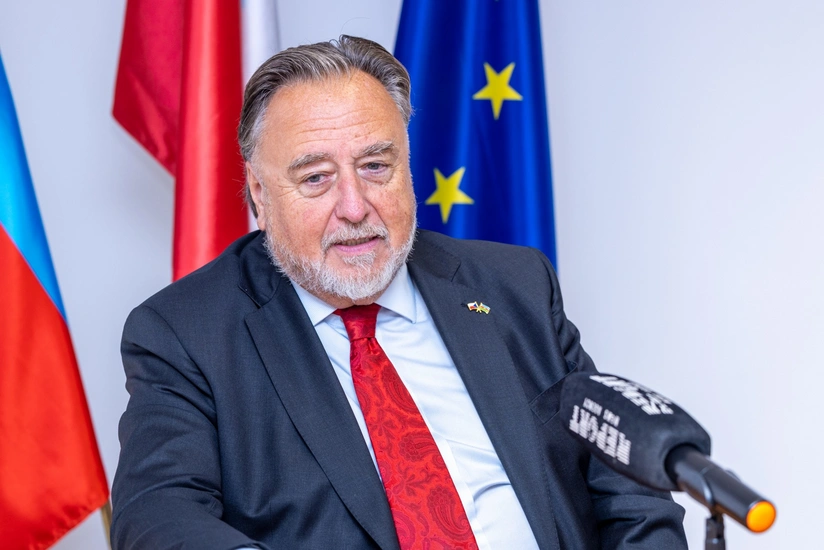
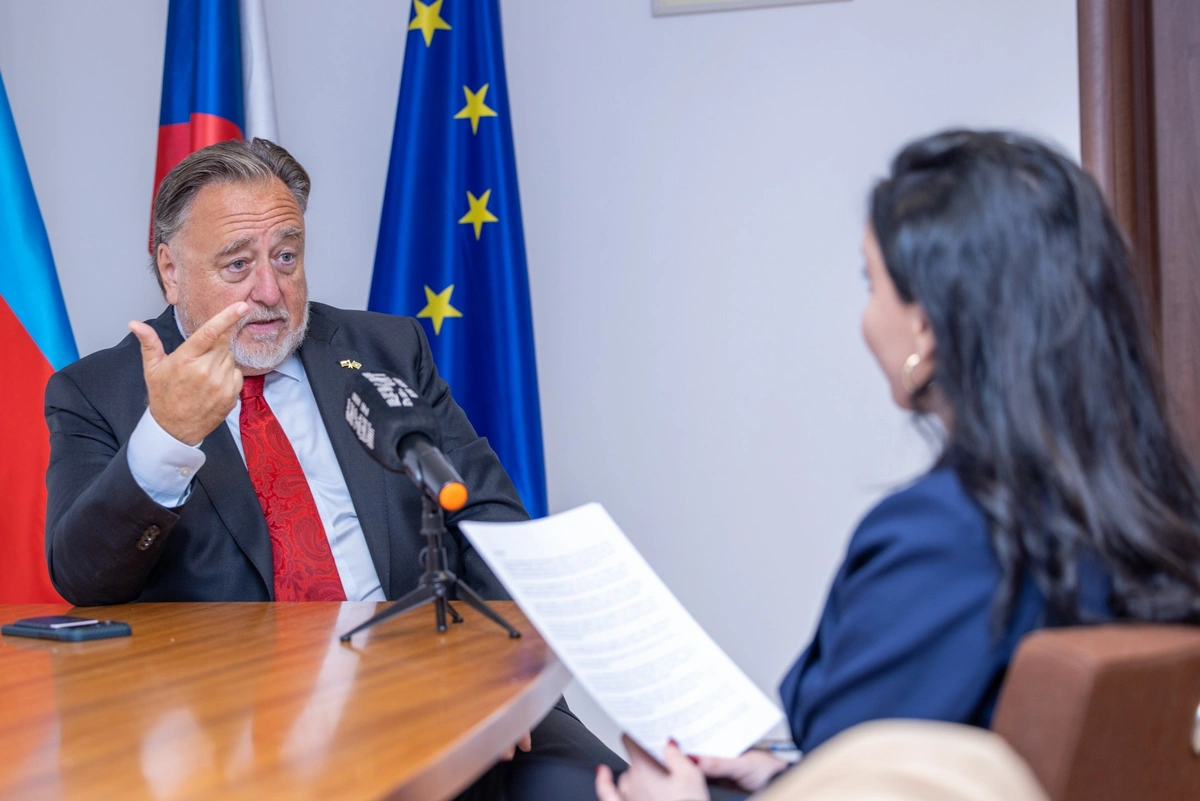
In an interview with Report, Milan Sedláček, the Ambassador Extraordinary and Plenipotentiary of the Czech Republic to Azerbaijan, spoke about the dynamics of political dialogue between the two countries, prospects for bilateral and multilateral cooperation, Azerbaijan–European Union relations, the peace process in the South Caucasus, the role of the Southern Gas Corridor in Europe"s energy security, and a range of other issues.
- This year, Azerbaijan and the Czech Republic are celebrating the 32nd anniversary of the establishment of diplomatic relations. In your opinion, how has the political dialogue between the two countries developed in recent years and what steps can be taken to further deepen these relations in the future?
- In recent years, the political dialogue between Azerbaijan and the Czech Republic has been developing very dynamically and positively, as evidenced by intensive contacts at a high political level and a focus on mutual economic interests. Azerbaijani President Ilham Aliyev meets informally with Czech Prime Minister Petr Fiala several times a year. Bilateral talks were also held on the occasion of the COP 29 conference in Baku. Regular joint working groups dealing with projects in the field of innovation and the green economy, more intensive cultural exchanges, and the use of multilateral platforms could contribute to deepening relations.
- How does the Czech Republic, as a member of the European Union, assess Azerbaijan's cooperation with the EU? In what other areas, apart from the energy partnership, do you think relations between the EU and Azerbaijan could enter a new phase of development?
- As a member of the EU, the Czech Republic considers Azerbaijan's cooperation with the EU to be strategically important, particularly for the diversification of energy supplies in the context of global challenges. In addition to energy, potential new areas include transport infrastructure (e.g., integration of the Central Corridor), exports of energy from renewable sources, and digital innovation, where Azerbaijan's green ambitions are in line with the EU's sustainable development goals.
- How does the Czech Republic view Azerbaijan's initiatives aimed at promoting regional stability and cooperation against the backdrop of recent geopolitical changes in the region, including progress in the peace process in the South Caucasus?
- In the context of geopolitical changes, including progress in the peace process between Armenia and Azerbaijan, the Czech Republic welcomes Azerbaijan's initiatives aimed at stability in the South Caucasus as a basis for regional prosperity and limiting external influences. This includes support for connectivity projects that promote economic integration and are seen as an opportunity to strengthen ties between the Czech Republic and Azerbaijan.
- When and where is the next meeting of the Joint Intergovernmental Commission between Azerbaijan and the Czech Republic planned to be held? Also, we would like to know the date and location of the next round of political consultations between the Ministries of Foreign Affairs.
- As you are aware, elections were recently held in the Czech Republic and a new government has not yet been appointed, which will determine all subsequent steps. We expect both events to take place during the next year.
- How do Azerbaijan and the Czech Republic cooperate within international organizations? What prospects exist for strengthening this cooperation in the future?
- Both countries actively cooperate within organizations such as the UN, OSCE, and other multilateral platforms. There is great potential for deepening cooperation in the areas of global security, sustainable development, and climate initiatives, as well as for coordinating positions on regional stability and energy security.
A good recent example is the International Transport Forum, which is currently chaired by Azerbaijan, with the Czech Republic serving as first vice-chair. The International Transport Forum is the only global body that deals with all modes of transport. The ITF is administratively integrated into the OECD but is politically autonomous.
- How does the Czech Republic assess the prospects of the Southern Gas Corridor for ensuring Europe's energy security?
- The Czech Republic considers the Southern Gas Corridor to be a strategic project that contributes significantly to the diversification of energy supplies and reduces dependence on a single source. Its further development is essential for strengthening Europe's energy resilience and stability.
- In recent years, Azerbaijan has paid special attention to the development of renewable energy sources. What is the Czech Republic's interest in cooperation in the field of hydrogen technologies and green energy?
- The goal of the Czech Republic's updated National Energy and Climate Plan is to achieve a 30.1% share of renewable energy sources in gross final consumption by 2030 (in 2024, the Czech Republic's share was 18.6%).
Czech companies are therefore ready to contribute in areas such as design, engineering services, and the manufacture of high-quality equipment for renewable energy projects.
When it comes to hydrogen, the Czech Republic, through NET4GAS, the transmission system operator in the Czech Republic, provides its customers with cost-effective, safe, and reliable transmission services through a network of gas pipelines (mainly hydrogen) with a total length of more than 4,000 km. Thanks to its location in the center of Europe, the Czech Republic can use three of the five main transport corridors within Europe for hydrogen imports. These are the North Africa and Southern Europe corridor, followed by the Scandinavia-Baltic States corridor and the Eastern and Southeastern Europe corridor.
Czech companies also have something to offer in the field of hydrogen and can participate in the entire supply chain. For example, we offer tanks or pressure cylinders for the storage and transport of hydrogen, as well as the production of fittings or equipment for testing fuel cells.
- One Czech company is already involved in the modernization of a hydroelectric power plant in Azerbaijan. What specific results have been achieved? Are there any new projects planned in this area? What other infrastructure or energy projects could Czech companies participate in?
- The modernization project has improved the efficiency and extended the life of the hydroelectric power plant. New projects in the field of renewable energy sources and the modernization of the distribution network are being considered. Czech companies could also participate in the development of infrastructure, including smart grids and energy storage systems.
The Czech Republic is also ready to share its experience and technologies in the field of renewable energy sources, including bioenergy, waste utilization, and waste management.
- Azerbaijan is actively exploring opportunities for developing battery energy storage systems. What solutions can Czech companies offer? Does the Czech Republic see prospects for cooperation in the development of battery technologies and their integration into the country's energy system?
- Currently, dozens of battery storage facilities for power balancing services in the order of tens of MWh are beginning to be built in Czechia. The Czech Republic still has considerable network capacity for connecting battery storage facilities.
The Czech Republic can offer comprehensive solutions for the production, storage, and use of electricity from renewable sources. One example is the intelligent energy management platform (EMS Podium).
Author

Photo