
 Baku 29° C
CBA aims to create equal competition conditions for Islamic finance
- 17 June, 2026
- 12:05
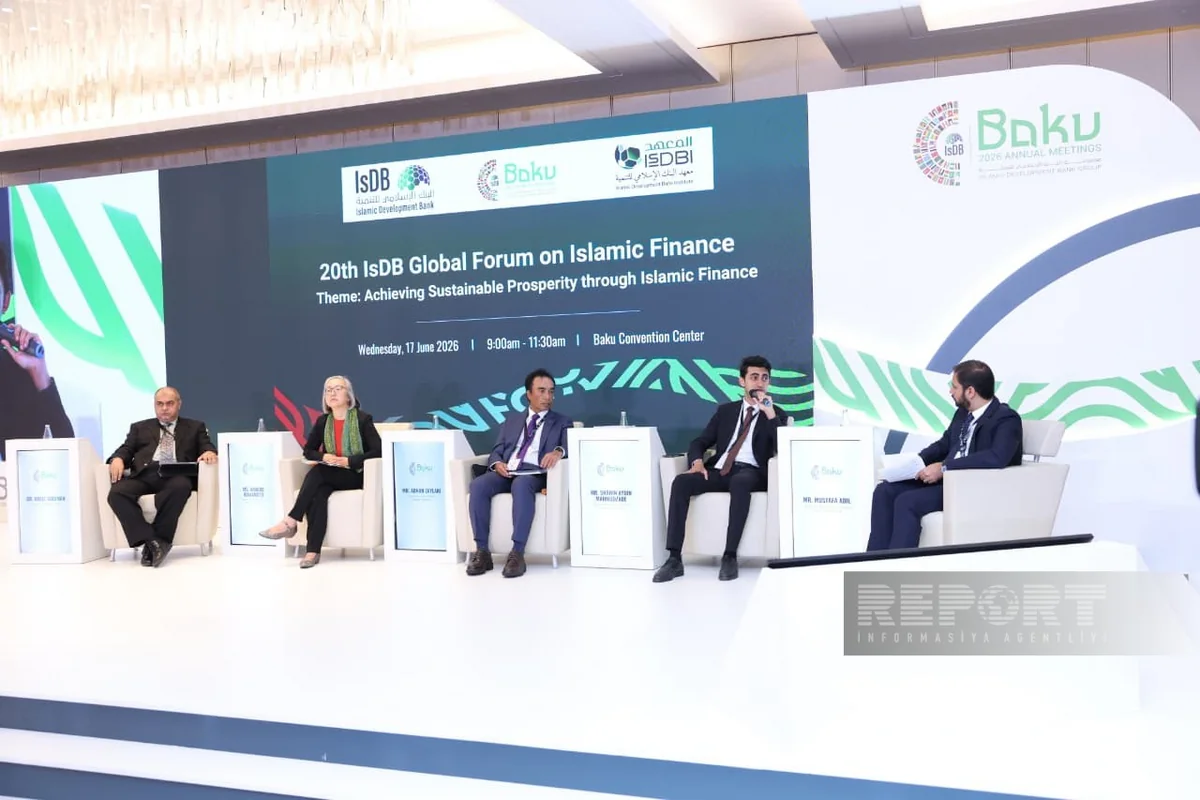
Interest in Islamic finance is high in Azerbaijan, but the level of understanding remains insufficient, Shahin Mahmudzada, Executive Director of the Central Bank of Azerbaijan (CBA), said at the 20th IsDB Global Forum on Islamic Finance in Baku within the framework of the Islamic Development Bank (IsDB) Group's 51st Annual Meeting, Report informs.
"When we first took steps toward Islamic finance, I must admit we did not have a clear understanding of whether there was genuine demand in the market. At that time, several studies were conducted, and about 80% of participants emphasized the need for Islamic finance in Azerbaijan. However, nearly 70% of citizens perceived Islamic finance as charity, assuming banks provided money without expecting repayment. This situation highlights significant gaps in financial literacy. To some extent, this is expected, since Islamic finance is relatively new for our country and is still in the formative stage for the financial sector, the Central Bank, and society as a whole," Mahmudzada noted.
The official added that the principle of "triple neutrality" exists for Islamic and traditional banking: "The first is tax neutrality. When the tax system is not neutral, financing costs in Islamic finance are artificially increased. It is precisely for this reason that, thanks to the amendments made to legislation, both banking models gain the opportunity to compete on equal terms on the asset side. The second is the issue of deposit insurance. In some countries, this mechanism has not been adapted in parallel. In conditions of low financial literacy, it is unrealistic to expect citizens to trust the system without any guarantees. Therefore, the purpose of the reforms carried out within the framework of deposit insurance is to create an equally trustworthy environment in Islamic banking as well. The third and one of the most important directions is neutrality in monetary policy. Banks do not generate their income solely through the loan portfolio; they also place their liquid assets in capital and money markets, as well as in AMB instruments. If these instruments are not adapted to Islamic finance, banks cannot earn sufficient income from liquid assets. As a result, the profit share in Islamic finance products has to be increased, which weakens their competitiveness."
He stressed that the main goal of new legislation is to establish neutrality in the financial system: "That means setting equal and competitive standards for both conventional and Islamic banking. Unfortunately, in some regional partners and countries transitioning from conventional to Islamic finance, this approach is not fully observed, as institutional frameworks are not updated in parallel."
According to Mahmudzada, the industrial sector's investment is crucial: "If industries do not invest, the Islamic finance model cannot function. We analyzed demand for Islamic windows more precisely and hope that by the 2031 IsDB Annual Meeting, we will present higher figures than today's $1.3 billion. But industry's role is decisive. We only set the rules, while market participants play the game. Without real willingness and investment in professional, technical, and infrastructure capacity, the model will not work."
Author