
 Baku 16° C
34 years pass since tragedy in Azerbaijan's Garadaghly
- 17 February, 2026
- 09:09
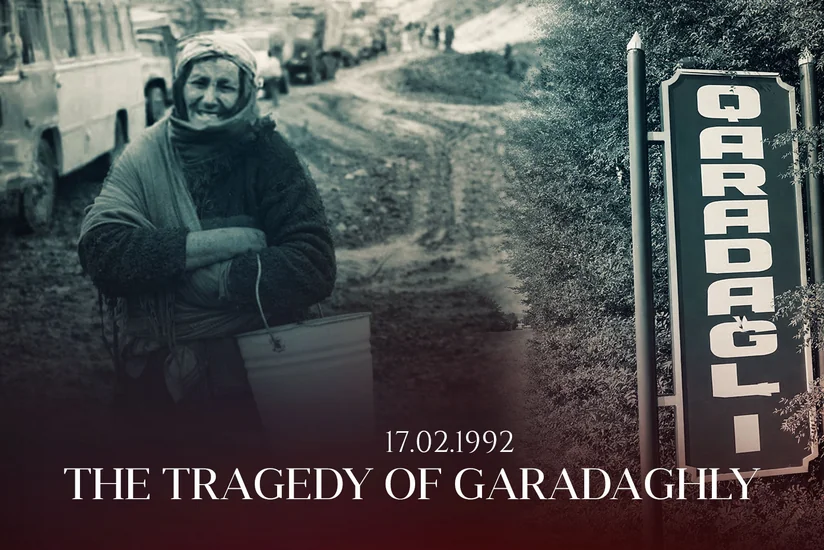
Today marks the 34th anniversary of the massacre of Azerbaijani civilians by Armenian armed groups in Garadaghly village of Azerbaijan's Khojavand district, Report informs.
For four years, residents of Garadaghly in Azerbaijan's Khojavand district heroically fought off attacks by Armenian invaders. On February 17, 1992, the village was occupied and burned. The Armenian occupiers committed a brutal massacre against the villagers. This act of genocide, committed 34 years ago against innocent Azerbaijanis, was the result of Armenian nationalists' hatred of Azerbaijanis.
The village of Garadaghly is located 13 kilometers west of the district center, on the Khojavand-Khankandi road, at the foot of the mountains. In 1988, after Armenian separatists unleashed the conflict in Karabakh, the tragedy in Garadaghly began. The villagers selflessly defended every inch of their native land, and dozens of villagers fell in an unequal battle with heavily armed Armenian thugs.
On January 24, 1990, three villagers were brutally murdered by Armenians at the 6th kilometer of the Khojavand-Khankandi road. On January 9, 1991, a UAZ vehicle was fired upon by Armenian militants, killing one and wounding four. Two of the victims died from their wounds. On March 8, 1991, two people were horribly murdered by Armenian forces near the village of Garadaghly. On June 28, 1991, six people – three men and three women – were killed on a farm near the village. On September 8, 1991, a bus traveling from Aghdam to Garadaghly was fired upon by Armenian forces at the 5th-6th kilometer of the Khojavand-Khankandi road, killing two men and six women. On January 8, 1992, another Azerbaijani was brutally murdered near the village.
On December 19, 1991, the village of Khojavand was occupied and burned, and on February 12, 1992, the Shusha village of Malibayli suffered the same fate. The village of Garadaghly became the next target. The situation in the village worsened, drawing closer to the day of the tragedy.
On February 14, 1992, Armenian armed forces, supported by the 366th Motorized Rifle Regiment stationed in Khankandi, launched an offensive on Garadaghly. For four days, 104 village residents and 14 soldiers selflessly repelled the attack by Armenian armed forces. Fourteen people were killed, including one woman. The village defenders, left without ammunition, were taken prisoner by the Armenian forces.
On February 17, 1992, the village of Garadaghly was occupied and burned by Armenian thugs. As many as 118 villagers were taken hostage, and 33 were executed. The captives were subjected to inhumane torture, and the Armenians committed monstrous murders of Azerbaijani civilians.
The Armenian executioners dumped the bodies of the dead, along with those who were wounded but still alive, into a silo near Garadaghly and covered them with earth. The rest were taken into captivity. A total of 68 captives died, and 50 were rescued with great difficulty from the enemy. However, 18 of them later died, unable to withstand the physical and mental torture they endured in captivity. Captured Azerbaijanis were subjected to such barbaric and sophisticated executions as beheading, burying them alive, extracting teeth, depriving them of food and water for extended periods, beating them to death, and other similar atrocities.
In the village of Garadaghly, two families lost four members each, 43 families lost fathers and husbands, and approximately 146 children were orphaned. A total of 91 people were killed in the village, or one in ten residents of Garadaghly. As many as 200 residential buildings, a community center, a school for 320 children, and a 25-bed hospital were destroyed. Approximately 800 village residents became refugees.
The tragedy in Garadaghly is called a second Khojaly. One in ten residents of the village was killed.
To inform the international community about the reality of the Garadaghly tragedy, the Khojavand District Executive Authority initiated the production of a documentary film, "Genocide: Garadaghly," in Azerbaijani, Russian, and English, as well as films, "The Garadaghly Genocide: Continues..." and "Garadaghly, the Struggle," in Azerbaijani, Russian, English, and French. A book, "The Garadaghly Genocide in Eyewitness Stories," was published. Furthermore, memorial complexes have been erected in the villages of Yeni Garadaghly, Yeni Khojavand, and in the Nargiztapa area to perpetuate the memory of the martyrs.
In accordance with the trilateral statement signed on November 10, 2020, following the Second Karabakh War, the village of Garadaghly was within the zone of responsibility of the Russian peacekeeping forces. Following localized anti-terrorist operations conducted in Karabakh on September 19-20, Azerbaijan regained control of the village.
Author